

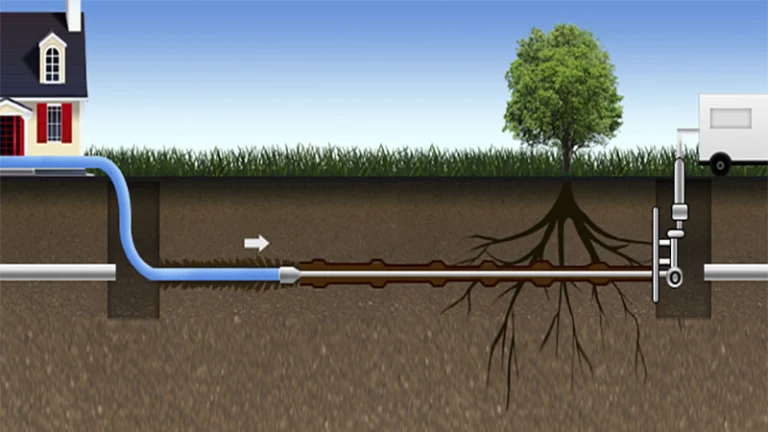
Most homeowners assume fixing a broken sewer line means days of digging and a yard that looks like a construction site for weeks. Our full plumbing services include trenchless sewer repair, which can replace or rehabilitate a damaged line with very little disruption to your property. Understanding how the process works helps you decide whether it’s the right fit for your situation.
Trenchless sewer repair fixes a damaged underground pipe without excavating a trench along the full pipe run. Plumbers create one or two small access points, then either insert a liner inside the existing pipe or pull a new pipe through the old one. Most residential jobs are finished in a single day, and the yard stays largely intact.
Two approaches cover the large majority of trenchless sewer repair jobs.
Pipe lining, also called CIPP, is the more common method. A flexible liner coated in resin is inserted into the damaged pipe and inflated against the pipe walls. The resin cures and hardens into a smooth, continuous new pipe inside the existing one.
Pipe lining works well for cracks, joint failures, and moderate corrosion. It does reduce the pipe’s interior diameter slightly, but not enough to affect flow in most residential sewer lines.
Pipe bursting is used when the existing pipe needs full replacement but excavation isn’t the preferred option. A bursting head is pulled through the old pipe, fracturing it outward while simultaneously drawing a new pipe into position.
The replacement pipe is typically HDPE (high-density polyethylene), which resists corrosion and carries a long service life. Pipe bursting is effective even when the original pipe is significantly deteriorated.
Here’s what a standard trenchless job looks like:
The full process typically takes four to eight hours for a standard residential sewer line, but, in some cases, it can take up to three days.
This is the part most guides leave out: trenchless has real limits.
Not every sewer problem qualifies. Traditional excavation is still the right call in these cases:
A qualified plumber will tell you straight if your situation requires traditional excavation. Anyone who recommends trenchless without running a camera first is guessing, and that’s a sign to keep looking.
Watch for these indicators that your sewer line needs attention:
Two or more of these at once is a reliable signal to schedule a camera inspection before the problem gets worse. Early diagnosis keeps a manageable repair from becoming a full replacement.
Not every plumber offers trenchless sewer repair, and experience and equipment vary considerably among those who do. Look for a company that:
Fort Collins Heating & Air Conditioning has been serving this area since 1934. If you’re dealing with a sewer line issue, we’ll inspect the line, show you what the camera finds, and recommend the right solution for your specific situation. Call us to schedule.